Heavy, grueling and heaving are not words many people would be aware of from the world of track.
But the discus and shot put events stand out as the exception.
Cal High throwers take pride in their unique sports, giving spectators a glimpse of a tough track season that does not involve running.
For senior captain Olivia Horton, her throwing journey started freshman year when she heard about the sport through her friends.
“So freshman year I played basketball and I heard about track,” Horton said. “A lot of my friends were doing it, so I thought it would be a good way to get into another sport.”
To the untrained eye, throwing might look like a sport of raw strength, but it is deeply technical. While many track athletes fight against the clock, throwers fight against gravity.
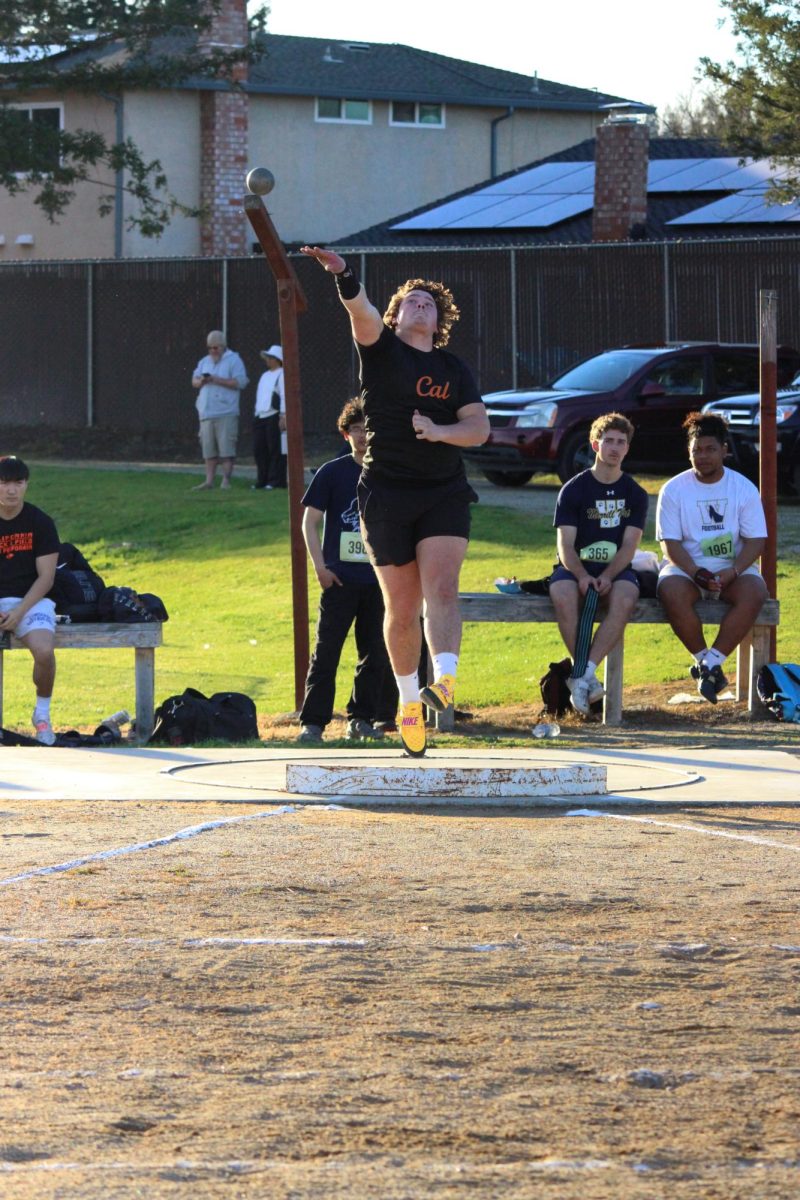
Shot put involves “putting,” or pushing, a heavy metal ball which weighs between 8.8 pounds for girls and 12 pounds for boys. Discus requires athletes to throw a metal “plate” which is smaller than a Frisbee but weighs 2.2 pounds for girls and 3.5 pounds for boys.
While having the strength to push or throw these objects through the air is key, technical skills are more valuable.
“I would say skill definitely does help to be strong but practicing my skills over and over has helped me increase my distances even more than just being big,” senior Zach Bruce said.
This belief stands when athletes compete, no matter how big or how small they are.
“It’s a lot more technical than people think,” senior captain Magnus Carlson said. “You really have to be an athlete and lock in your form to be competitive.”
Getting the skills down is not a quick and easy feat, as throwers spend most of their practice focusing on what to improve on and accelerating from there.
“The best way for improving is to get as many reps in as possible and make sure that they are all quality reps,” sophomore Brandon Lewandowski said. “Only focus on one thing that you need to improve every practice and success will follow.”
While techniques and repetition is key, strength remains a very important aspect of throwers’ routines.
“If you consider plyometrics lifting, then we lift everyday,” Bruce said. “Then we have weights every other day starting on Monday, and a lot of us go to the gym on our own time too.”
Cal’s throwers continue push past their limits and continuously break records, both in the weight room and on the field.
Carlson broke Cal’s all time squat record last summer by squatting 575 pounds. He also broke the school’s record for all squat, bench, and clean combined with a total weight of 1,185 pounds.
The previous record and title of “Iron Grizzly” was set by Matt Shrimplin in 2016. Shrimplin squatted 535 pounds and had a total of 1,120 pounds combined for squat, bench, and clean.
Another notable thrower on the track and field team is sophomore Sanjana Ginjupalli, who has broken a few records of her own in her first year.
Ginjupalli said she has broken both of the frosh/soph girl’s throwing records so far, with a 33-foot, 3-inch foot shot put throw and a 100-foot, 6-inch discus throw.
Despite the individual nature of the sport, the Cal throwers have built a culture that can be considered as a family. Their familial like bond is fostered through longstanding team ritual post meet.
“[We] throwers like to go out to eat after meets and practice,” Horton said. “It’s really fun and helps our diet.”
She said that her personal favorite is Dave’s Hot Chicken, while Bruce likes to hit Chipotle.
The captains are a key part of the team chemistry by setting the necessary tone for practices and the meets.
“I definitely try to bring a good, positive energy for my teammates, especially the newer ones, and try to set a good example to bring them up to speed,” Carlson said.
The team takes pride in their warm ups and practice, both of which are ingrained into their strict routine, often set by one of their most tenured athletes.
“We go to the field and do a couple stretching routines and run on the field,” Horton said. “Then we do plyos which involve jumping over hurdles and onto stepping stools of various heights. We do it to build our leg muscles and work on the transition of power to get the most out of our throws.”
Despite the events flying under the radar, they remain among the most physically and mentally challenging sports.
“It is very body demanding due to the different positions that you need to hit during the throw,” Lewandowski said. “You can’t just walk in thinking you’re going to dominate just because you are big and strong which can be a confidence killer.”