Reading is an essential and unavoidable part of daily interactions and functions in people’s lives.
Literacy is something that is so crucial to operate as a member of society that it might be difficult, if not impossible, to imagine a world where people struggle with this basic skill in their everyday lives.
But new studies show that this might become a reality during the rising digital age as there’s a growing decline in accessible resources that help promote literacy.
A study conducted by the University of Florida and University College London reveals that reading for pleasure on a daily basis has declined more than 40% over the past 20 years.
“Our digital culture is certainly part of the story,” Jill Sonke, director of research initiatives at the University of Florida Center for Arts in Medicine, told University of Florida News.
This is concerning for many Cal High students.
“I wasn’t aware of the statistics,” freshman Adrianna Davis said. “I read books and my schoolwork thoroughly sometimes, but it truly depends on if it’s important to me. I’m not really shocked by the results, though, because I think we kind of became obsessed with social media.”
Cal librarian Nikki Ogden noted that freshmen usually come on to campus being really interested and enthusiastic about reading, but the interest starts to plateau around the end of their freshman year.
Ogden said this plateau is often caused by a loss of small moments in reading engagement.
“People used to read a lot, in what was called edge reading, where you have five or 10 minutes where you’re waiting for your ride or something like that, and you would read,” Ogden said. “But now, you mess around on your phone. The addictive nature of phones, I think, is also playing a big role.”
Edge reading is no longer prominent due to the effects of doomscrolling on social media sites such as TikTok and Instagram. Even during short moments where there is seemingly nothing to do, people are tending to entertain themselves with their screens rather than books.
“Everybody’s enthralled with their doomscrolling on different apps, social media usually,” sophomore Izzy Keate said. “I think that to contribute to fixing this, we probably need limits on the amount of time teenagers can spend on social media per day.”
While Keate said she hopes the statistics will improve, she doesn’t see that happening unless major changes in people’s habits start happening.
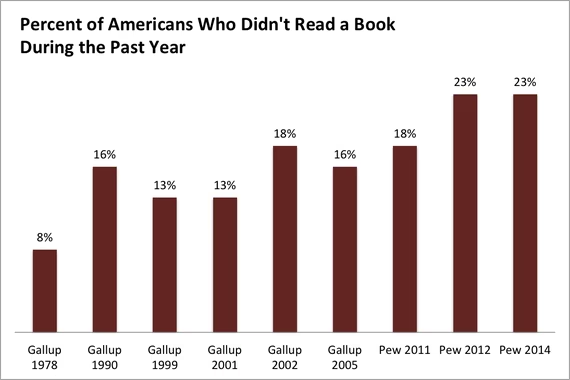
Surveys conducted by Gallup New and Pew Research Center show the number of Americans who didn’t read a book during the past year has jumped from 8% in 1978 to a whopping 23% in 2014.
But it’s not only reading for pleasure that has declined recently.
The National Report Card released on Jan. 29, 2025, shows consistent decreases in student reading levels, which have been declining steadily since shortly prior to the COVID-19 pandemic in 2020, according to the National Assessment Governing Board.
The COVID-19 pandemic forced a stark shift in the lifestyles of people, especially students, because schools shut down. The shift from in-person school to online learning created strong negative effects on students academic performances, and certainly on literacy rates.
“These kids weren’t in school when the pandemic happened, but [some] were in early childhood and preschool,” Associate Superintendent of Minnetonka Public School Amy LaDue said in an article published by the Los Angeles Times. “Their opportunities to have those experiences outside of their home that build literacy skills and to apply them with peers probably were impacted because they were home.”
Although students had more free time to read during the pandemic, screens grabbed many students’ attention, instead of books.
As a result, about 40% of fourth graders today are working below the National Assessment of Educational Progress Basic level in reading, the worst it has been since 2002.
“I think this is scary, because books are really a way to tell our histories and to form our thinking of the future,” AP Literature teacher Ginger Clarke said. “I think there’s a lot of distractions that students have access to, and things that are more appealing than reading.”
In addition, there is a physical lack of reading culture in schools.
“I think it’s a cultural shift. I think that there’s less support for reading in schools and in the community.” Ogden said. “A lot of schools no longer have school libraries anymore, and they don’t actually have credentialed librarians in them anymore.”
The effects of ignoring the alarming rates of America’s decline in literacy levels are starting to display that it might be time for students to pick up a book.