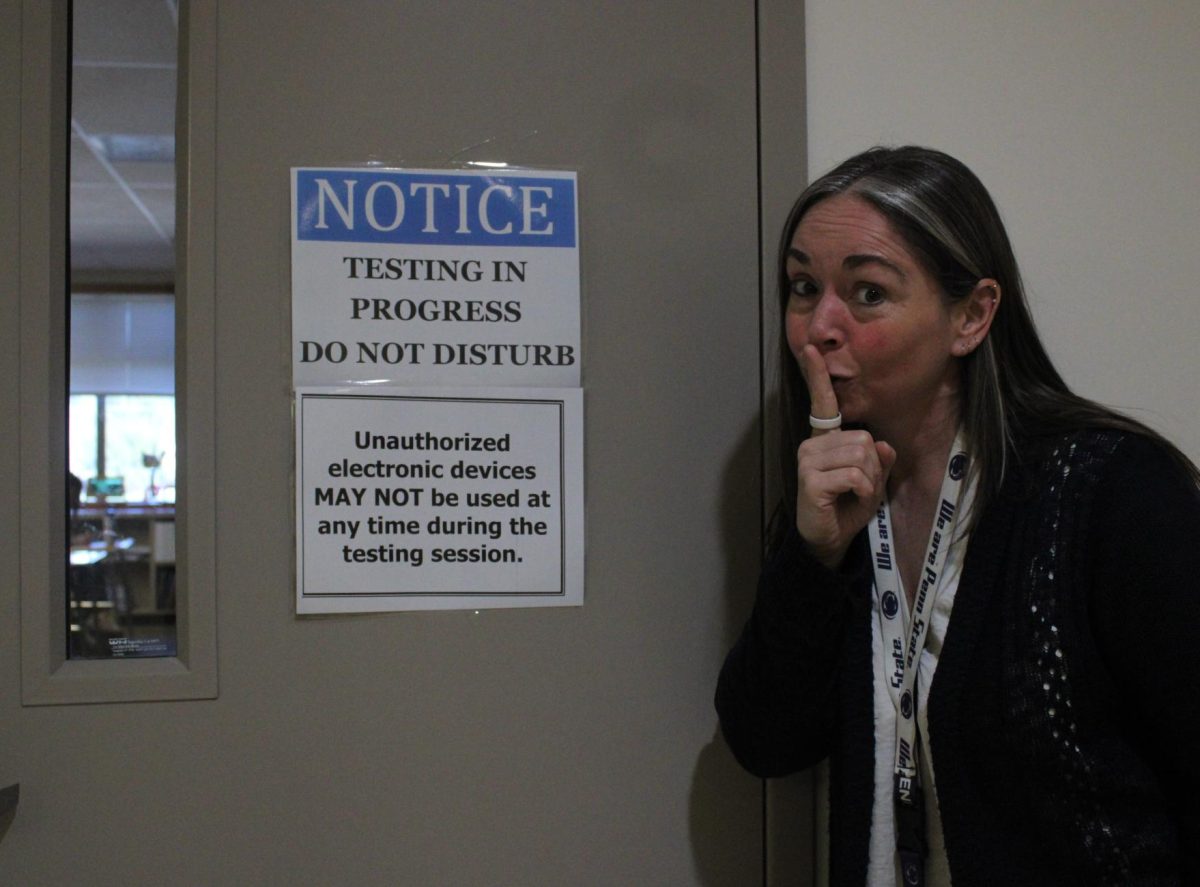
YES
The California Assessment of Student Performance and Progress (CAASPP) is a statewide assessment that is dreaded by all of the students who take it.
These tests cause unnecessary stress and take away from valuable instructional time in the classroom and should be eliminated for good.
Testing anxiety is becoming an epidemic amongst students, enforced by social standards and the increasing need to stand out in accordance with the struggle to get into colleges.
According to the Cureus Journal of Medical Science, 75.5% of students were found to be stressed out before the exam. The majority of the students faced difficulties in academic performance due to test anxiety.
This added stress affects the outcome of assessments like CAASPP.
The test evaluates students’ ability to digest the mathematical and English language arts information shared by their teachers in order to determine the amount of government funding the district receives.
One-time assessments should not be a determining factor in a student’s ability to maintain information, nor should they be a determining factor in funding for schools.
Instead, progressive tests should be conducted at schools to monitor student growth throughout the year.
Using progressive tests would monitor the effectiveness of the curriculum because they would monitor student growth, assessing the same concepts and comparing results as students learn throughout the course of the year.
The tests would be more thorough and provide a better understanding of students’ growth in their learning.
CAASPP, in its essence, is a reflection not of the students’ growth and learning but instead, the effectiveness of the curriculum. It only assesses grade-level skills, which provides an unfair advantage to students who are a few years ahead in subjects like math.
While these students have excelled in their advanced classes, the CAASPP may not reflect that due to students’ disdain for the tests.
Plus, it tests some subjects, such as science, that students are not required to take every year.
Recently, students who have realized the test may have minimal impact on them have rushed through the test and completed it with minimal effort.
Some students will write a singular sentence in the essay portion of the CAASPP, or answer randomly on the multiple-choice questions.
These actions have damaged the district’s reputation because test results then show students not learning. According to The Campanile, Palo Alto High’s newspaper, this affects students poorly, even if they have high scores, since the individual scores are not shared.
A big problem of standardized testing is that it is heavily influenced by the affluence of the area in which we live.
Students in San Ramon Valley Unified School District have more opportunities to learn test materials because we have the money to afford textbooks and laptops for our students. Students in other areas may not have access to these materials and, consequently, may do worse on the tests.
These are things students often take for granted, not realizing that by purposely failing these state tests, the funding for classroom resources could be at risk. For schools that do poorly, the state may intervene and increase its influence on students’ education.
State intervention could lead to putting a band-aid on a much larger problem instead of addressing the root cause, since the state is a third party.
Teachers have complained that in some subjects, the disruption to classes is inequitable. In prior years, ELA and math classes are disrupted by juniors having to take CAASPP tests during class.
This year, Cal has attempted to remedy this with a new testing schedule where only those students testing were on campus at that time.
But as a result, all classes’ instructional time was reduced.
It’s not worth it to have six days of testing disrupt the regular school schedule. It can be detrimental to classes such as AP’s, which run on tight schedules. Overall, CAASPP testing in its current state is more hassle than it is worth and should be eliminated.
Lauren Aparicio, Staff Writer
NO
As the annual dreaded California Assessment of Student Performance and Progress test (CAASPP) has come and gone once again, Cal High’s student body couldn’t help but bring up the discussion about how necessary the mandatory state test really is for learning.
In elementary, middle, and high schools across California, students have sacrificed multiple hours of educational time just for CAASPP testing.
Because of this, and a variety of other reasons, the test is universally hated by most students.
The CAASPP, was established in 2014 by the California Department of Education and is taken once per year by students at certain grade levels.
English Language Arts and mathematics assessments are taken by students in third, eighth and eleventh grades.
The California Science Test is taken by students in fifth, eighth and twelfth grades.
The CAASPP assessment is a burden for students, but it is necessary for the state of California to improve the state’s education system.
The California Department of Education website indicates that the CAASPP is an academic check-up on students to ensure they are learning everything they need to know at specific grade levels.
The CAASPP provides important data and information for educators so they can determine if students are meeting basic standards in English, math and science.
And if some skills students are not learning, the test provides teachers with valuable feedback about how to improve instructions and lessons to strength these skills.
The results of the CAASPP test are also used to measure the quality of education at school sites to make sure everyone is getting the same high quality education. If there are large gaps in scores in a certain subject area, schools can get the resources to help students improve in those areas.
Because of this, if the CAASPP test is eliminated then education will become less personalized and tailored to schools needs, and will decrease in quality.
The CAASPP is also needed to help inform parents and teachers if students are academically prepared for the next steps in their educational journey.
This is especially vital because of the massive layoffs and defunding of the U.S. Department of Education, which is proving to be unfit to make positive changes for state education systems anymore.
If certain schools do poorly on standardized testing, the state’s Department of Education can help provide the school with the support it needs to improve, something that should benefit all students. The Department of Education can also reassess classroom curriculum and intervene to improve poor performances moving forward.
Although not one of the main goals of CAASPP testing, students who are not testing on those six days are providing with a nice break from long school days.
For example, during the first four days of testing at Cal, freshmen, sophomores and seniors were allowed to sleep in and didn’t have to arrive to school until classes began at 10:45 a.m. Underclassmen benefited from this schedule for an additional two days when seniors joined the juniors for science testing.
Despite the tedious nature of the testing, it is needed to prevent California’s quality of education from declining and to make sure students who graduate are career and college ready.
Elsa Rhyne, Staff Writer