Demogorgons and the Mind Flayer are back.
The animated “Stranger Things” spin-off, “Stranger Things: Tales from ’85,” was released on April 23 on Netflix, bringing the popular science fiction series back to life.
The series was developed by Matt Duffer and Ross Duffer, who created the original series, in conjunction with Shawn Levy and Dan Cohen, who also worked on the original series.
Execuctive producer Eric Robles also helped developed the animated series with Flying Bark Productions.
The first two episodes were screened in theaters on April 18 for a special show.
The project has been described to be inspired by classic Saturday morning cartoons, suggesting a slightly different tone while staying connected to the original story’s world.
Set in the same universe as the original “Stranger Things,” the spin-off focuses on new adventures in Hawkins, Indiana between Seasons 2 and 3 of the original show.
Some fans remain skeptical.
“I feel like it won’t feel the same because the actors are a big part of the show,” freshman Melvin Namai said. “But, I’d watch at least the first episode to see if it’s good.”
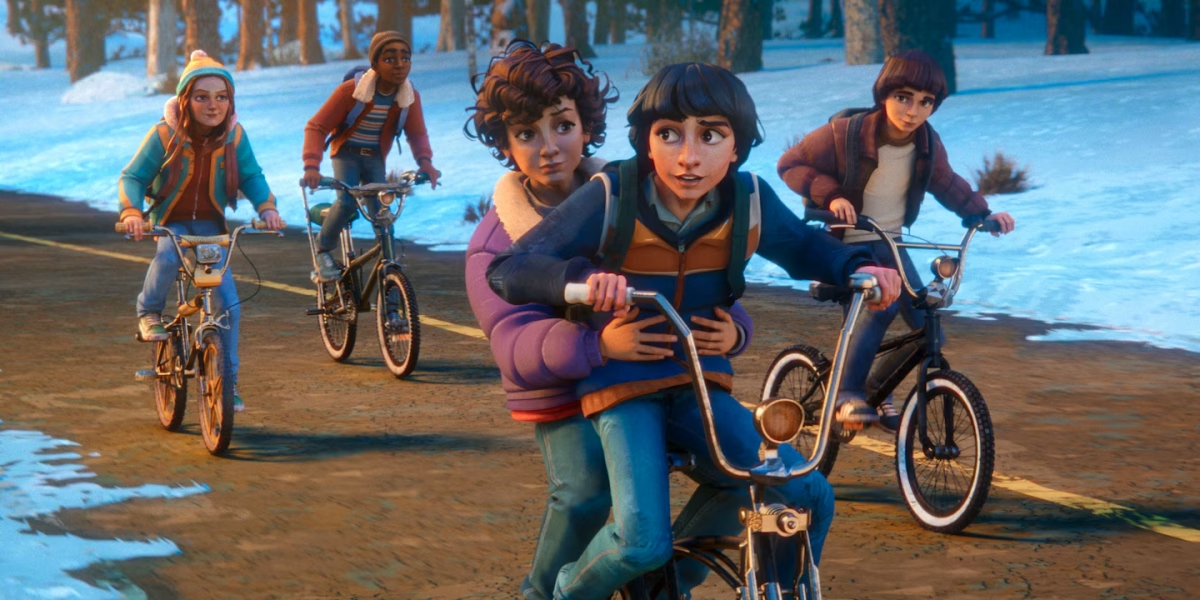
The animation blends 1980s cartoon nostalgia with modern, rich colors and intricate animation, continuing to align with the nostalgic tone that defines “Stranger Things.”
Featuring 10 episodes in the first season, the series follows the unexplored time period in 1985 after Season 2 when Hawkins is still recovering from the main villain, the Shadow Monster.
The show still follows the original characters Eleven, Mike, Lucas, Dustin, Will, and Max, while introducing the new character, Nikki Baxter, a punk styled newcomer who forms a close bond with Will.
In the show, creatures like mutated plants and pumpkin-like monsters begin to show up, and are connected to the Upside Down, which is a sinister, parasitic world that mirrors Hawkins.
As the group investigates, they uncover a new paranormal mystery affecting the town in each episode, bringing them to work together again.
“It feels like they’re stretching the story too much,” Namai said. “I’d rather they focus on finishing the main series instead of adding more spin offs.”
Unlike the main series, which ended with Season 5 on New Year’s Eve and built toward a single, over-arching conflict, the spin-off introduces smaller, self-contained mysteries that contribute to a broader understanding of the Upside Down and its threat to Hawkins.
But students are divided. Is this series a creative twist on a fan favorite story, or just a cash grab by unnecessarily drawing out a successful franchise?
“I thought it’s a cool idea,” freshman Audrey Freji said. “It sounds less like a random spinoff and more like expanding the world, especially since it’s set during a time we didn’t fully see.”
Instead of continuing the traditional storyline of what fans have seen in the original series, the animated show explores new, independent stories that expand the world, spotlighting different characters and unexplored moments.
The animated style also allows the series to visually hone in on supernatural elements, making the Upside Down and its creatures even more visually intense.
“I think that it won’t be as scary, but will still be as emotional as the original series,” freshman Emily Wada said.
Wada also noted that while the show may still carry emotional depth, the shift in format could change how audiences experience it.
“Animation gives more flexibility, but it won’t be the same as the live action,” Wada said.
Some student are curious to see how the animation will affect the core elements that made the original show so appealing. while others are questioning whether the story needs another version at all.
Many fans are primarily excited to see if the new format opens the door for different storytelling, giving them a reason to stay interested in the world of Hawkins months after the original series ended.
“I was excited seeing different side stories being told, but I don’t think it’ll be as impactful as the actual show,” freshman Julianna David said.
While David appreciates the idea of expanding the story, she also feels the changes may take away from what made the original series so strong.
“Right now it feels unnecessary because of the major changes to the plot,” David said.
Beyond just storytelling, the animation taps into the emotional connection audiences have built with the franchise over time.
The first season of “Stranger Things” was released on July 15, 2016, allowing high school audiences to grow up with the series and cast, fostering an emotional attachment to the overall franchise.
“It’s a cool idea and it’s perfect for fans who are nostalgic about the older seasons,” senior Sophie Tran said. “Season 3 especially had a vibe that was very special to me, so I’m looking forward to more content during that time of the show.”
Tran believes that the animation will still have valuable features to offer to audiences. She believes “Stranger Things’” underlying themes of friendship, community, coming-of-age, and challenges will remain.
Tran believes these messages are important for people to hang on to, and that there is still more to take away from the series.
“Even if some people think that the Duffers are just trying to drag a plot that should be over by now, I still think most would be grateful for more content especially since the show is over and so many people have grown up with it and gained a sort of attachment,” Tran said. “At the end of the day, ‘Stranger Things’ has so many powerful messages to offer, and an animation is a great way to keep the fanbase alive.”
Whether “Stranger Things: Tales from ’85” is a meaningful expansion of the series or simply an unnecessary extension of the brand, a loyal fanbase and unexplored timeline contributes to the show’s potential to valuably add to the franchise or prove that some stories are better left untouched.