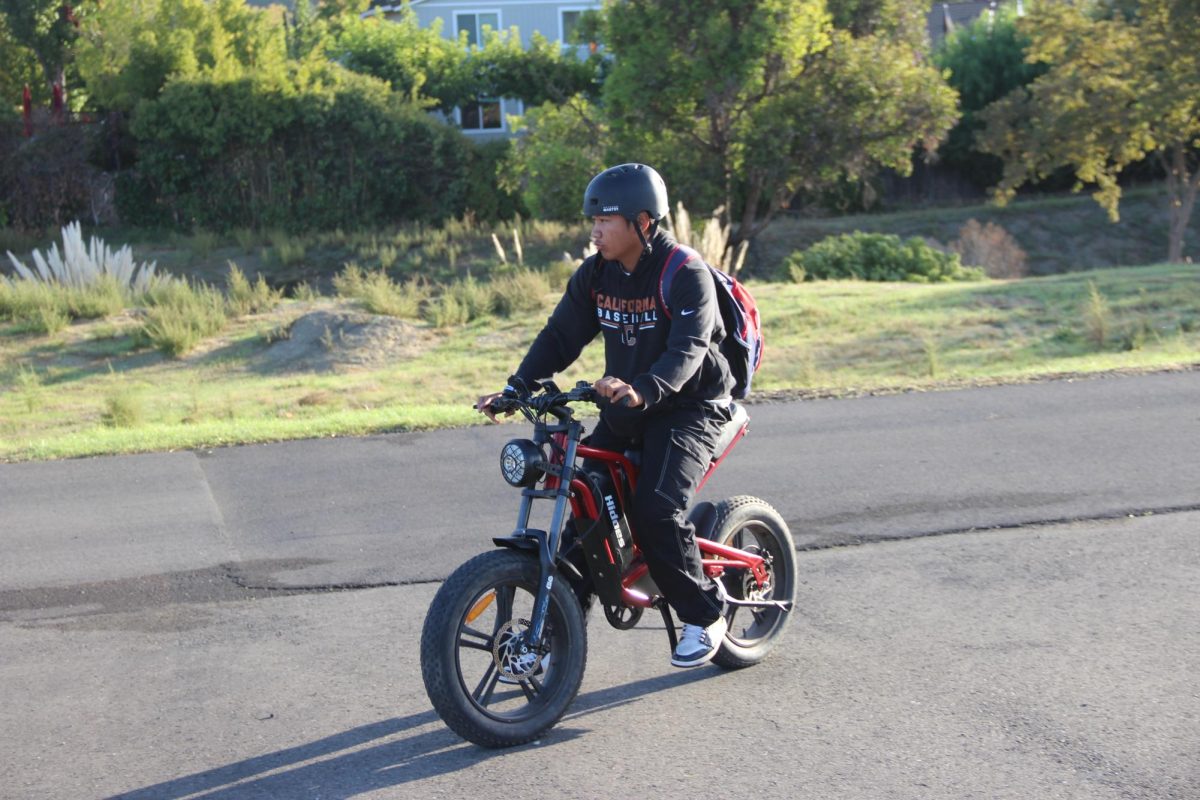
As transportation has become more electric and futuristic over the past few years, electric bikes (ebikes) and electric scooters (e-scooters) have taken over the student body by storm.
They’ve taken a more dominant role in forms of transportation and commute for students, many of whom scoot or ride to school or around town. According to a survey The Californian emailed to students, 46 of the 87 respondents (52.9%) indicated they own either an ebike or an e-scooter.
Some students own ebikes and escooters because they said they are a more time efficient method of transportation and they are more environmentally friendly than riding in a car.
“It saves time for parents from dropping kids to school,” freshman Ram Ravilla said.
Students said ebikes and e-scooters also limit roadway traffic around campus by decreasing the amount of cars on the road.
Students also said riding e-bikes are not only efficient, but is also fun way to travel to a destination.
“They are good, fast, and fun when driven responsibly,” freshman Shourya Ghosh, an owner of a Class 2 ebike, said.
But, other students argue that people drive ebikes too fast and students use them irresponsibly.
“Some kids go really fast on [ebikes],” junior Olivia Pearson said. “I think that this easy access to high speeds makes it more dangerous to ride in the street or around cars.”
Many students are unaware of the different laws and requirements for each class of ebikes. The differences between them are pretty negligible, but there are California laws restricting ebikes for those who don’t own a drivers license.
Class 1 ebikes are pedal assisted bikes, meaning they offer a pedal powered boost while riding, to reach a maximum motor assisted speed of 20 miles per hour.
Similarly, Class 2 ebikes reach a speed of 20 miles per hour with the assistance of throttles, which are twisting mechanisms on the handlebars that activate the motor without pedaling.
Class 3 ebikes are also pedal assisted like Class 1 ebikes, but their maximum motor assisted speed reaches 28 mph.
According to Assembly Bill 1096 of California law, students need a learner’s permit or driver’s license to drive a Class 3 ebike or an e-scooter.
The same bill also requires everyone age 17 and younger to wear a helmet for all ebikes and e-scooters, and for everyone 18 and older to wear a helmet on Class 3 ebikes and e-scooters.
Cal High student resource officer Stephen Akacsos has encountered many scenarios involving illegal usage of ebikes.
“I’d say one in eight kids usually don’t have a helmet on,” Akacsos said.
While all students can ride Class 1 and Class 2 ebikes legally, they need a driver’s license or a learner’s permit to driVarve a Class 3 ebike or an e-scooter.
Despite this, two of eight students (25%) who indicated in the survey they owned a Class 3 ebike and seven of the 18 students (38.9%) who owned an e-scooter were freshmen.
California law also states that the speed limit on nature trails, such as the Iron Horse Trail that runs behind campus, is 15 mph.
Many students indicated in the survey that they have witnessed others driving at speeds exceeding 20 mph on the trial.
“On a daily basis, definitely,” Pearson said about how often she sees ebikes traveling above the speed limit. “When kids are going to school or leaving school, I think there’s a lot of ebikes, e-scooters around campus.”
There are many reasons students exceed the speed limit on their electric vehicles.
“When we’re on our ebike or e-scooter, it’s just easy to kind of get zoned in,” Akacsos said. “On top of that, the bike or the scooter is heavier than a normal scooter.”
While Akacsos said the San Ramon police department can confiscate ebikes and scooters, he said enforcement hasn’t reached those levels yet.
“Technically, the police can tow your bike or scooter,” Akacsos said. “In San Ramon, we’re not there yet. We’re still trying to go the education route.”
The education route refers to police calling the parents of a student who violates ebike and e-scooter laws to discuss the illegal usage. In addition, students may be ticketed for violating ebike and e-scooter laws.
While riding an ebike underage or over the speed limit doesn’t normally warrant a large punishment, police have been stopping students who aren’t following the laws more often.
“I know in the town of Danville, they’ve been cracking down quite a bit over the last few weeks or the last couple of months when it comes to young people, students, riding bikes without helmets or the fast ones on a trail,” Principal Demetrius Ball said. “So, it’s a community effort being led by the police departments in San Ramon and Danville.”
Ebikes and e-scooters have a lot of benefits to the student body, but if they aren’t regulated better among the student body, it could lead to major safety consequences.